Thank Goodness You're Here!

Panic2024Xbox Series X|S, PlayStation 4, PC (Microsoft Windows), PlayStation 5, Mac, Nintendo Switch
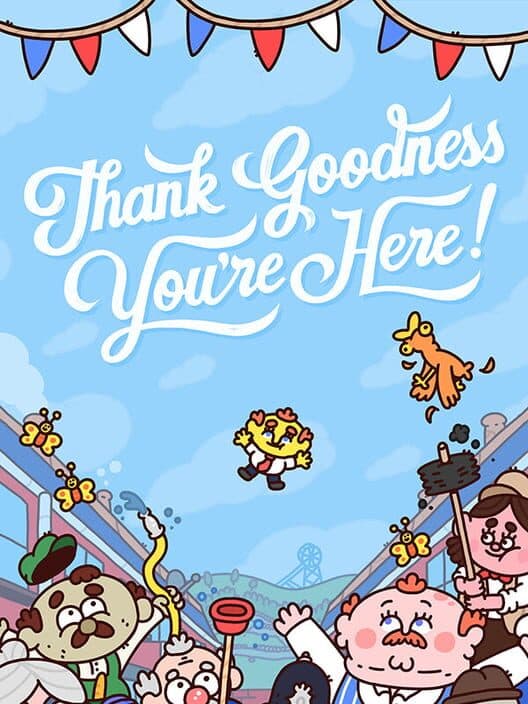
Absurd British comedy in explorable town

Short 2–4 hour story, tightly paced

Very easy, chill, interruption-friendly sessions

Is Thank Goodness You're Here! Worth It?

If you enjoy weird British comedy and do not mind a very short game, Thank Goodness You’re Here! is absolutely worth your time. It delivers a dense stream of bespoke jokes, oddball characters, and charming animations packed into just a few hours. You are not grinding levels or optimizing builds; you are essentially walking through an interactive cartoon special, choosing which corner of town to poke next. For busy adults, that brevity is a huge plus: you can start it on Friday night and comfortably see credits before the weekend ends, with no guilt about leaving anything “unfinished.” Buy at full price if you value sharp writing, distinct art, and a focused, no-filler experience more than raw hours per dollar. Wait for a sale if you strongly prefer longer adventures or tend to replay games many times. If slapstick, surreal British humor, or heavily dialogue-driven experiences are not your thing, you might bounce off quickly and should probably skip it. But for the right audience, it’s a delightful little burst of comedy that knows exactly when to end.

When is Thank Goodness You're Here! at its best?

When you want something fun after work but have little energy for complex systems, this is perfect for an hour of wandering, laughing, and stopping without any lingering obligations.

Great for a cozy weekend evening on the couch, where you and a partner or friend can pass the controller and react together to the town’s increasingly ridiculous situations.

Ideal as a break between heavier games: you can finish the whole thing in one or two sittings, feel satisfied, and move on without adding another long-term commitment.

What is Thank Goodness You're Here! like?

Thank Goodness You’re Here! is wonderfully easy to fit into a crowded life. The entire story takes roughly 2–4 hours, so you can see everything meaningful in one long evening or two shorter sessions. There is no grind, no daily checklist, and no ongoing “live service” pull begging you to come back. Scenes are structured as short vignettes that usually resolve within a few minutes, creating obvious points to pause or quit. Autosaves handle progress for you, and loading drops you right back into town, ready to wander again. Because there are no complex systems to remember, coming back after a week or two is painless—you just walk, talk, and follow the next marker that catches your eye. It’s purely single‑player, so you do not have to coordinate with friends or stick to a schedule. The main decision is simply when you want a concentrated, TV‑episode‑length burst of weird humor, not whether you can commit to a 50‑hour epic.

Tips

  • Treat it like a short mini‑series: plan one or two 60–90 minute evenings and expect to roll credits without needing a big time investment.
  • When home life is unpredictable, pause during free exploration rather than mid‑cutscene so it is easier to remember what was happening later.
  • Do not stress about seeing every gag; focus on the main arc first, and only wander for extras if you genuinely want more time in the town.

In this game, your brain gets a pretty easy ride. Most of your time is spent strolling through town, reading short lines of dialogue, and pressing a button to trigger the next gag. There are no complex menus, builds, or overlapping systems to track. You do need a bit of focus to catch the humor, especially with regional accents and quick visual jokes, but it is closer to following a sitcom than solving a puzzle box. Moments that demand real concentration, like a slightly trickier jump or a rapid‑fire sequence, are rare and forgiving. Because the world is safe and nothing punishing is happening in the background, you can glance away from the screen during exploration without anxiety. For a busy adult, it’s an ideal “half‑focus” game: engaging enough that you feel present, but relaxed enough that you can play when a bit tired or occasionally interrupted by conversation or your phone.

Tips

  • Use subtitles if you are multitasking so you do not miss punchlines when you glance away or someone talks over the dialogue.
  • When tired, focus on one exclamation mark at a time rather than sweeping the whole map; it keeps the wandering from feeling mentally noisy.
  • Check the map whenever you return after a pause so you instantly recall where new characters or scenes are waiting.

This is not a game you “git good” at, and that’s by design. Within the first 15–30 minutes you will have learned every meaningful control: move, jump, interact, maybe one or two simple variations. After that, the challenge is not execution but just finding the next interesting person or hotspot. There are no combos to optimize, no builds to craft, and no hidden systems that only reveal themselves after dozens of hours. For many adults, this is a relief: you can drop in without committing to a long learning curve or worrying that rusty skills will punish you later. The trade‑off is that practicing does not dramatically change the experience; becoming smoother at movement makes things a bit more fluid, but you do not unlock a higher level of play. The reward here is familiarity and comfort, not mastery. If you usually play demanding games, this works best as a light palate cleanser rather than a long‑term skill project.

Tips

  • Spend your first few minutes pressing every button and interacting with whatever you see; once you understand how jokes trigger, you have basically learned the whole toolset.
  • Do not replay scenes just to perform them “perfectly”; accept clumsy runs and enjoy the animations rather than treating practice as a goal.
  • If you are sharing the controller, let less experienced players take turns—they will not hold anything back because the game barely punishes awkward inputs.

This is one of the gentlest emotional rides you can choose. There are no life‑or‑death battles, no timers breathing down your neck, and no brutal losses of progress. Even the scenes that look chaotic are framed as slapstick, not danger. When you slip up, the game either rewinds you a few seconds or turns the mistake into another gag. That keeps your heart rate low and makes it easy to laugh off missteps instead of tensing up. The overall tone is playful and surreal rather than dark or heavy, so you are never bracing for a gut‑punch twist. For a busy adult coming off a long day, this feels closer to putting on a funny cartoon than tackling something like a difficult action game or horror title. It’s engaging without being draining, and you can comfortably play it right before bed without winding yourself up.

Tips

  • If you are coming from a stressful day, remind yourself early on that nothing serious is at stake here; let yourself treat mistakes as part of the comedy.
  • Pause freely during louder or busier sequences if your nerves are frayed; the game will happily wait while you take a breath.
  • Lean into the absurdity instead of chasing perfection—if a scene goes sideways, laugh at it rather than replaying just to “do it right.”

Frequently Asked Questions